

According to reports by Standard Media, users of cooking gas in Kenya, will soon no longer be able to conveniently buy or refill gas cylinder at neighborhood kiosks or petrol stations.
Refills only be carried out at outlets run by oil marketing companies who own the brand of your gas cylinder, instead.
This is as a result of new regulations abolishing the current exchange pool which was created in 2009.
The current mandatory cylinder exchange pool which is comprised of 50 marketers, enabled consumers to trade their gas cylinders at any outlet without regard to the brand of their cylinder.
The exchange pool was at first created to ease access to Liquefied Petroleum Gas (LPG), but unfortunately had the unintended consequence of increasing illegal trade of the commodity.
Marketers of Liquefied Petroleum Gas (LPG), made it known that they lost control of their cylinders when the regulations were scrapped in 2009.
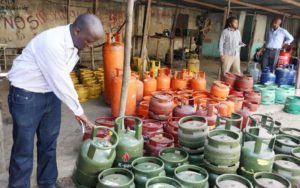
The Chairman of the Petroleum Institute Of East Africa, Olagoke Aluko said, “The vast majority of branded cylinders were never returned to their original branded owners. Instead, the empty cylinder would move into a parallel market, be illegally refilled and returned back to retailers for sale again,”.
This led to industry players lobbying for the exchange pool getting scrapped.
While the new rules which will be in effect in 2 weeks, are bound to greatly inconvenience consumers, they will, on the flip side, enhance user safety as they squarely place the responsibility of ensuring gas cylinders are safe on the LPG marketers.
This means the marketers will be held accountable directly, for accidents caused by gas leaks, including compensation to victims.
The Director-General of the Energy and Petroleum Regulatory Authority (EPRA), Pavel Oimeke while speaking during the launch of a campaign to sensitise industry players on the new regulations organised by the Petroleum Institute of East Africa in Nairobi, said “The current regulations had not been clear as to who owns the cylinder between the user and the marketing companies. The new regulations are clear that the brand owners are the owners of the cylinders and if there is an accident, the owner will take responsibility,”.
Although the companies will have a leeway to create voluntary exchanges they will however, need the Competition Authority of Kenya’s approval.
This is in order to prevent a few firms from forming an exchange that would lock out competitors.
Pavel Oimeke added that users will now pay a refundable deposit while acquiring cylinders.
The fee will be refunded, when the user returns the cylinder back to the owner.
One downside for consumers, is the fact that the prices of gas cylinders are not standardised.
Mr. Oimeke however, reaffirmed that the unified valve will, however, still be in use, thus allowing households a degree of flexibility in choosing cylinder brands.
What does this new development mean for you? Do you use or own a cooking gas cylinder? Do you know better alternatives? Will you be affected by the change? If yes tell us how.
Let us hear from you.
