

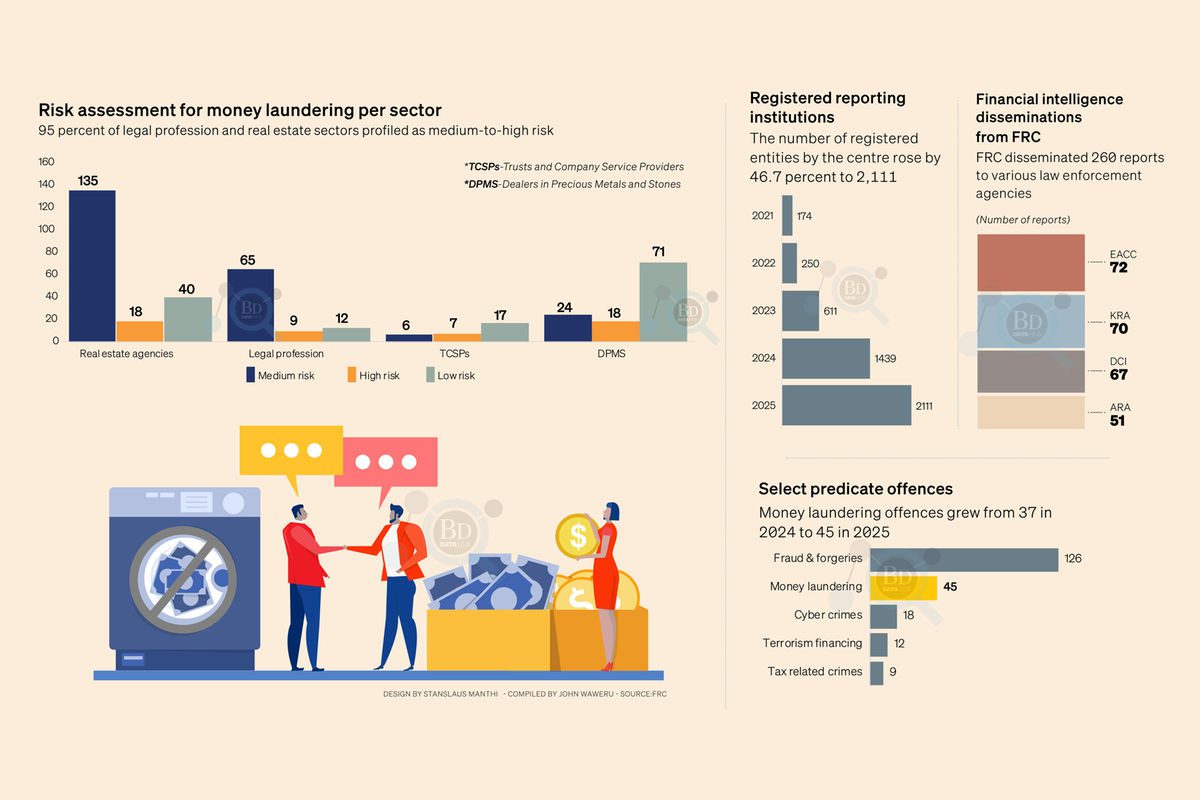
More than half of the firms flagged for higher exposure to money laundering risks are in the real estate and legal services sectors, putting these two sectors at the forefront of Kenya’s fight against illicit financial flows.
A 2025 Financial Reporting Centre (FRC) risk assessment reveals that 282 of the 442 entities profiled across four sectors fall into the medium- or high-risk categories, highlighting persistent gaps in anti-money laundering controls.
The real estate sector recorded the highest exposure, with 153 agencies classified as medium or high risk, compared with just 40 rated low risk. The legal profession followed, with 74 firms in the medium-to-high-risk bracket and only 12 considered low risk.
The findings come as Kenya steps up efforts to exit the Financial Action Task Force (FATF) grey list, where it was placed over weaknesses in combating money laundering and terrorism financing.

Grey-listing increases scrutiny of financial transactions and risks limiting access to global capital if reforms stall.
“About 95 percent of the legal profession and real estate sectors were profiled as medium- to high-risk, triggering the 2026 on-site inspection cycle,” the FRC said.
FRC Director-General Naphtaly Rono said the agency, which serves as the country’s financial intelligence unit, would intensify inspections of real estate firms and law firms this year.
“As we move into 2026, we will rededicate our efforts to active, ground-level supervision of the legal profession and the real estate sector as high-risk areas for money laundering,” the FRC said.
The property market is especially vulnerable because of the widespread use of cash, the involvement of politically exposed persons (PEPs), and weak regulation. Criminals often channel illicit funds into real estate through cash purchases, structured deposits, smuggling, falsified documentation and inflated property valuations.
Opaque ownership structures, including shell companies and proxy owners, make it difficult to identify the true beneficial owners. Weak beneficial ownership checks and fragmented registries further facilitate money laundering, with domestic PEPs posing particularly high risks.
Legal professionals are also under scrutiny for facilitating complex transactions that can obscure the origin of illicit assets, especially where customer due diligence is inadequate.
Other designated sectors presented comparatively lower risks. Dealers in precious metals and stones had 42 entities classified as medium or high risk, compared with 71 rated low risk. Trust and company service providers, meanwhile, had 13 entities classified as medium or high risk and 17 rated low risk.
The concentration of high-risk entities in the real estate and legal sectors signals that future regulatory action is likely to focus on these industries as Kenya seeks to exit the FATF grey list.
Kenya is implementing an International Co-operation Review Group (ICRG) action plan under the FATF, focusing on legal reforms, risk-based supervision and prosecutions to secure its removal from the grey list.
